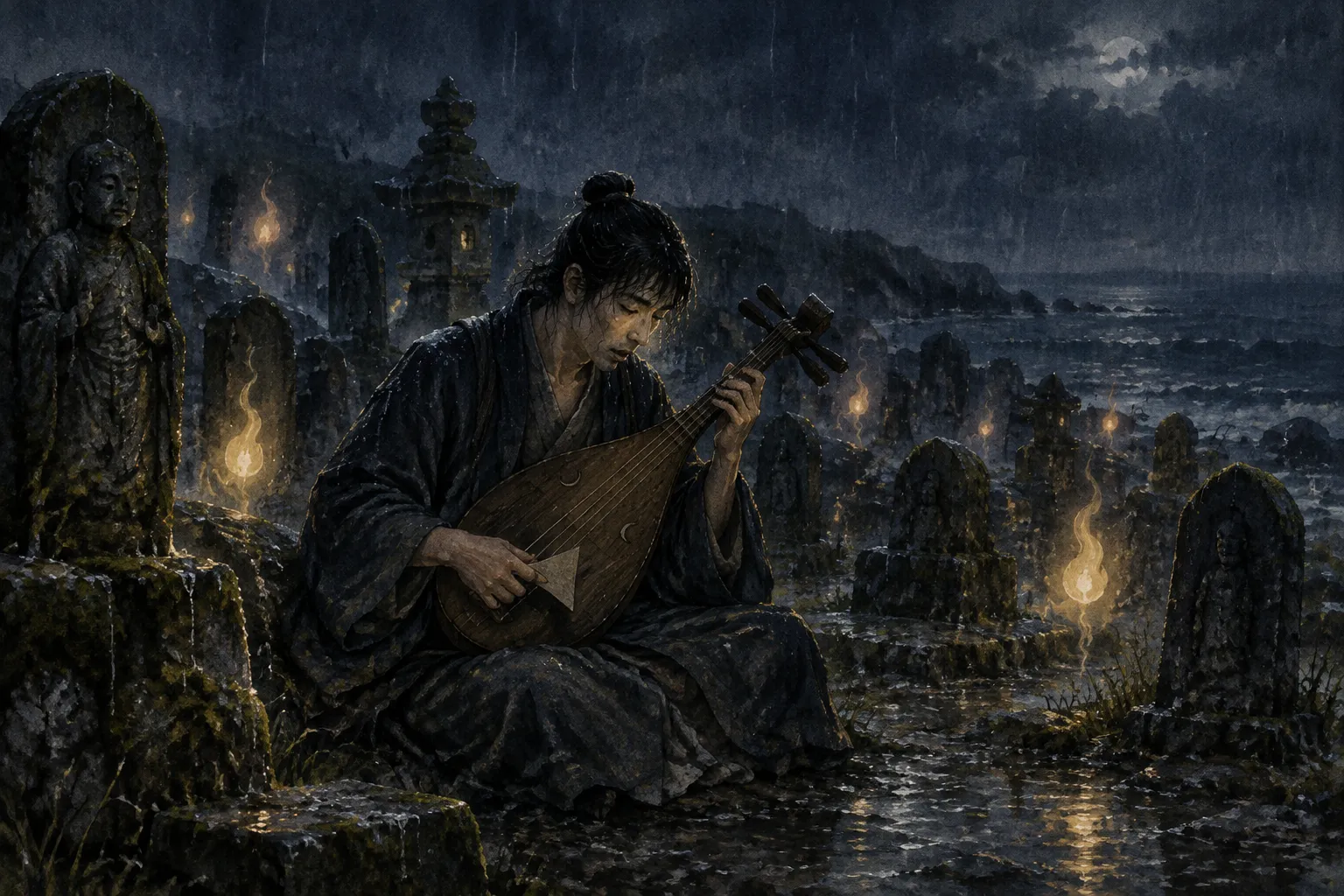
Hōichi believes he is performing before an audience of extraordinary distinction. He hears silk rustling, attendants moving, and voices speaking the language of a noble household. His listeners ask for the account of a terrible sea battle, then weep so violently that even the musician becomes frightened. What he cannot see is that he is sitting in a cemetery, singing to the people who died in the story.
That reversal lies at the heart of Lafcadio Hearn’s “The Story of Mimi-Nashi-Hōïchi”, published in Kwaidan in 1904. Its famous mutilation is only the ending of a more unsettling encounter: a gifted performer makes the past audible, and the past refuses to release him. Why do these ghosts want their own defeat recited—and why does a Buddhist text almost, but not quite, save their singer?
A haunted coast, not a timeless spirit world
Hearn locates the tale at Akamagaséki, by the Straits of Shimonoseki, and connects its haunting to the battle of Dan-no-ura. His opening identifies the opposing sides as the Heike, or Taira, and the Genji, or Minamoto, and remembers the drowned child emperor Antoku among the defeated. Hōichi’s adventure happens an unspecified number of centuries later. The battle and the musician’s encounter therefore belong to different layers of the narrative, not one continuous historical scene.
In Hearn’s description of the haunted shore, pale fires drift over the water and sounds resembling battle cries travel on the wind. The dead threaten passing boats and swimmers. Buddhist services at Amidaji and memorials in its nearby cemetery have reduced the disturbances without ending them. This is the story’s explanation of its landscape; it should not be mistaken for independently established temple history.
These spirits are not anonymous monsters. They retain a collective identity, a remembered catastrophe, and the hierarchy of a vanished court. That specificity matters. The tale is Japanese ghost literature with an explicitly Buddhist ritual setting, rather than a Shinto creation narrative or a general account of what all Japanese people believed about death.
The reading here follows Hearn’s English literary witness. His introductory note says that most of the collection draws on older Japanese books, but it does not supply a separate source history for every tale. We should therefore distinguish what this version actually says from claims about an original or universal Hōichi legend.
Why a biwa player can reach the dead
Hōichi is not an accidental passerby with a convenient musical instrument. Hearn presents him as a trained professional whose specialty is reciting the history of the Heike and Genji while accompanying himself on the biwa. Poor despite his ability, he has accepted lodging at Amidaji from a priest who enjoys his performances. Music gives him both a livelihood and a place in the temple household.
The profession has a real performing tradition behind it. The Tokyo National Research Institute for Cultural Properties describes Heike-biwa as musical recitation of The Tale of the Heike by blind performers known as biwa hōshi, accompanied on the lute. Its account places the tradition’s flourishing in the Muromachi period. Hōichi’s fictional skill thus belongs to a recognizable art, not an invented power unique to a supernatural hero.
Religious uses of the instrument also deserve distinction from this particular repertoire. The Metropolitan Museum’s nineteenth-century mōsō biwa is a fish-shaped wooden instrument that the museum cautiously associates with a wandering Buddhist monk. Its accompanying explanation connects biwa traditions with blind priests who traveled between villages singing sutras. That object is not Hōichi’s instrument, nor proof that every biwa practice was interchangeable. It does, however, provide concrete context for the proximity of music, religious performance, and itinerant musicianship.
In Hearn’s tale, the musician’s artistic excellence is precisely what exposes him. The dead do not summon him because he has insulted them. They summon him because he can tell their story exceptionally well.
The audience asks to hear its own catastrophe
The first visitor sounds like an armed retainer. He addresses Hōichi with an authority that makes refusal difficult, then explains that an important lord wishes to hear him perform. Once inside the apparent residence, Hōichi hears enough signs of wealth and rank to interpret the invitation as a professional opportunity. The promise of patronage makes the trap plausible.
When asked to recite the Heike history, Hōichi points out that the entire account would take many nights. His unseen hosts select Dan-no-ura. In the performance scene, his biwa evokes ships, arrows, clashing weapons, and bodies falling into the sea. Praise encourages him, but his account of the women, children, and imperial child’s deaths provokes overwhelming grief.
One possible reading is that the ghosts seek recognition rather than entertainment alone. They want a living voice to articulate suffering that has not become safely past. Hearn does not explain their inner motives in those terms, so this remains an interpretation. What the narrative does establish is that the requested episode is their own disaster and that hearing it produces anguish rather than peace.
The listeners demand further nightly performances and insist on secrecy. Concerned by Hōichi’s unexplained absences, the priest has servants follow him. They eventually discover him in the rain before Antoku’s memorial, surrounded by ghostly fires. Even when they interrupt, he objects as though they are behaving improperly before an eminent audience. The illusion preserves not just a building but an entire social situation.
Why the protective text misses his ears
Back at Amidaji, the priest explains that obedience has placed Hōichi in danger. He and his acolyte write the Hannya-Shin-Kyō, commonly called the Heart Sutra, across the musician’s body. The instructions are equally important: sit still, remain silent, and do not answer the returning visitor. Hearn names both the text and the protective procedure; the story does not present an unspecified magical inscription.
This reverses the earlier pattern of the encounter. Before, Hōichi responded to a summons and filled the night with sound. Now his survival depends on refusing response. For a performer whose voice has won such intense attention, enforced silence is a particularly exacting defense.
The protection works wherever the text has been written. When the retainer returns, he can see Hōichi’s biwa but cannot see the musician—except for two ears. Unable to bring back the singer, he tears off the visible ears as evidence that he has fulfilled his orders as far as possible. Hōichi remains silent despite the injury.
The omission is not Hōichi’s fault. When the priest returns, he admits that he entrusted the ears to his acolyte and failed to check the work. That admission prevents a simple moral about a disobedient musician receiving punishment. The religious defense succeeds within the story’s supernatural rules; human care in applying it is incomplete. Hōichi survives through both the protection and his own extraordinary self-control.
A survivor whose audience changes
Hearn does not end with the cemetery or even the wound. A doctor treats Hōichi, news of his experience spreads, and wealthy visitors come to hear him recite. The performer who began in poverty becomes prosperous, although the name “Hōichi the Earless” preserves the cost of his encounter. The closing passage gives him a continuing career, not merely a memorable death.
There is an uneasy symmetry in that ending. First the dead seek him because of his reputation; afterward the living seek him because of his encounter with the dead. His art survives, but his body carries the evidence of an audience that demanded too much.
Readers interested in another carefully distinguished Hearn narrative can turn to Yuki-Onna as wife and mother. Here, however, the central relationship is between performer and listener. Hōichi’s danger begins when artistic sympathy becomes compulsory service. His escape requires a boundary: the dead may have their story remembered, but they cannot be allowed an unlimited claim on the living person who sings it.
Sources and further reading
- Lafcadio Hearn, Kwaidan—the primary literary text for this reading, especially “The Story of Mimi-Nashi-Hōïchi” and the author’s introductory note.
- “The First Recording of Heike”—a 2018 research-institute report explaining Heike-biwa and documenting performance recording.
- “Mōsō Biwa”—a museum object record providing context for a distinct Buddhist biwa tradition.