
The villagers have left the body behind. A small Buddhist lamp burns beside the offerings, and a traveling priest keeps watch. Then something enormous and indistinct enters the room. Unable to move or speak, the priest watches it consume the corpse, its shroud, and finally the food intended for the dead. In Lafcadio Hearn’s “Jikininki,” the most disturbing revelation comes afterward: the creature was once a priest himself.
Why should a man who performed funerals become a devourer of bodies? Hearn’s answer makes the story more than a monstrous encounter. The dead priest had treated bereavement as a source of income without compassion. Now he depends on another priest to offer the care he failed to give. Read closely, this literary ghost story is about the difference between performing a religious duty and actually serving another being.
A mountain encounter in Hearn’s telling
The version examined here is the English-language tale in Hearn’s Kwaidan, whose author’s preface is dated January 20, 1904. Hearn explains that most of the collection’s stories came from older Japanese books, but that general statement does not identify the precise source of “Jikininki.” We should therefore distinguish this particular literary witness from an imagined, uniform Japanese belief about corpse-eating spirits. The text and its accompanying notes are our evidence for the narrative that follows.
Hearn places the encounter in the mountain country of Mino, identified in the edition’s notes with southern present-day Gifu Prefecture. His traveler is Musō Kokushi, introduced as a Zen priest. Lost and seeking shelter, Musō reaches a dilapidated hermitage. Its elderly occupant refuses him lodging but directs him toward a nearby hamlet.
This first refusal matters because it establishes an apparent contrast: an inhospitable religious recluse above, generous villagers below. At the headman’s house, Musō receives food, bedding, and a private room. Only later does he learn that his host’s father has just died. The household has concealed its grief so that an exhausted guest will not feel uncomfortable.
As a reading of Hearn’s arrangement, the villagers have already demonstrated the attentive kindness that the story will find missing from the former priest’s religious work. Their hospitality gives the later confession its moral weight.
Why everyone leaves the dead alone
Before midnight, the dead man’s son explains an alarming local rule. After a death, everyone must leave the village overnight. They make offerings and prayers, abandon the body, and return in the morning. Strange events follow, but breaking the rule has previously brought misfortune. This is the custom of the fictional hamlet as Hearn narrates it, not evidence that communities throughout Mino followed such a practice.
Musō chooses to remain. He does not accuse the family of cowardice. Instead, he regrets that he was not told sooner, because he could have performed the funeral service before their departure. His response establishes his vocation through willingness to help: tiredness does not excuse him from attending to the dead.
After the villagers leave, Musō performs the ceremonies and meditates beside the corpse. The intruding creature then reduces the funeral setting to a meal. Its appetite makes no distinction between the person’s remains, the shroud, and the offerings. Musō survives, but his religious identity does not prevent the experience from rendering him helpless.
At dawn, the villagers are relieved to find him unharmed. They are not surprised that the body has disappeared. Their familiarity with the result sharpens his isolation: what has overturned his understanding is, for them, a recurring fact of life within the tale.
The confession that changes the monster
When Musō asks about the hermit, the villagers insist that no priest has lived nearby for generations. He nevertheless returns to the hillside and finds the dwelling again. This time, the old man welcomes him and confesses that he was the creature in the death chamber. In Hearn’s confession scene, the monster’s defining emotion is shame.
Long before, he explains, he had been the district’s only priest. People carried bodies considerable distances for his services. Yet he performed the rites merely as business, thinking of the food and clothing his profession provided. After death, he was reborn as a jikininki, compelled to consume the corpses of those who died in the district.
The accusation is specific. The tale does not simply say that receiving material support makes a priest corrupt. Its speaker condemns his own exclusively selfish motivation. He had accepted the benefits of an office while neglecting the compassion that should have given the office meaning.
The punishment can consequently be read as a grotesque continuation of his former conduct. He once sustained himself through other people’s funerals; now he must literally feed on their dead. This is an interpretation of the narrative’s symmetry, not an additional doctrine stated by Hearn.
Crucially, the being does not boast about its appetite or threaten Musō. It asks for help escaping an existence it finds abhorrent. Recognition changes the reader’s task: the frightening presence must also be understood as a sufferer.
Jikininki and the Buddhist hungry ghosts
Hearn’s terminology requires care. His note translates jikininki as a man-eating goblin, mentions the term rākshasa, and tentatively connects this particular creature with a class of gaki, or hungry spirits. The qualification matters: Hearn’s own annotation offers an identification rather than a simple, universal monster taxonomy. This is a Buddhist-inflected ghost narrative, not a Shinto account of a kami.
Medieval Japanese paintings provide a useful, earlier context without proving a direct source for the story. The twelfth-century Hungry Ghosts Scroll in the Tokyo National Museum represents beings tormented by hunger and thirst, with emaciated bodies and swollen bellies. The museum explains their condition through Buddhist rebirth and describes their consumption of carcasses and human waste. Such imagery makes dreadful appetite a condition of suffering, not merely an appetite for harming others.
A different late-twelfth-century scroll, Kyoto National Museum’s Tales of Hungry Ghosts, emphasizes rescue. Its episodes include thirsty ghosts aided by offerings and people pouring water on a funerary marker. Another sequence connects Ananda with the transmission of a practice of offering food and drink to spirits, called segaki. These medieval works establish a Japanese Buddhist setting in which terrifying hunger and compassionate relief belong together.
They should not be treated as illustrations of Hearn’s exact monster. Neither museum identifies its scroll as depicting his hillside priest. Their relevance is narrower: they help explain why a corpse-eater’s appeal for religious assistance makes sense within the story’s Buddhist framework.
A request for help, not a confirmed release
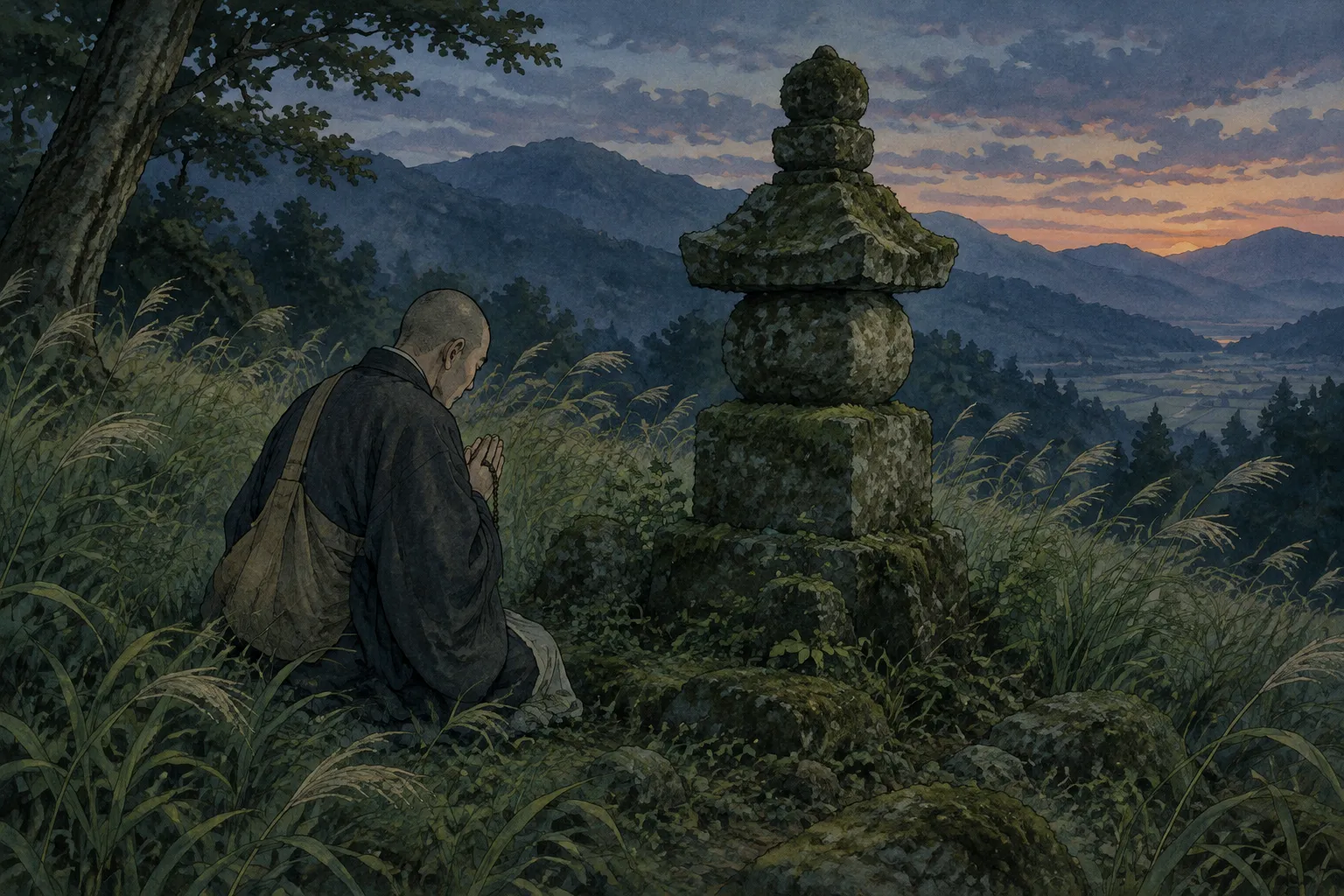
The former priest asks Musō to perform a segaki service on his behalf. Hearn’s note describes this as a Buddhist service for beings in the condition of hungry spirits. Then both the speaker and the hermitage disappear. Musō finds himself kneeling in tall grass beside an old, moss-covered, five-part stone funerary monument that seems to mark a priest’s grave. That is where Hearn ends the account.
The ending does not show the requested service being performed, nor does it explicitly confirm the spirit’s liberation. To say that Musō certainly saves him would supply a resolution the text withholds. What the story does establish is a new relationship: the being who once exploited the needs of mourners now depends on someone else’s unselfish religious care.
Readers of Hearn’s Hōichi the Earless and his ghostly audience will recognize another encounter in which Buddhist practice matters to relations between living and dead. Here, however, the decisive movement is from fear toward pity. The final image replaces the consuming monster with a neglected-looking grave. It leaves Musō—and the reader—facing not another attack, but an unanswered appeal.
Sources and further reading
- Lafcadio Hearn, Kwaidan: “Jikininki” and its notes — the primary literary text discussed here.
- Kyoto National Museum, Tales of Hungry Ghosts — medieval imagery of offerings and salvation.
- National Institutes for Cultural Heritage, Hungry Ghosts Scroll — the Tokyo National Museum scroll and its Buddhist context.


