
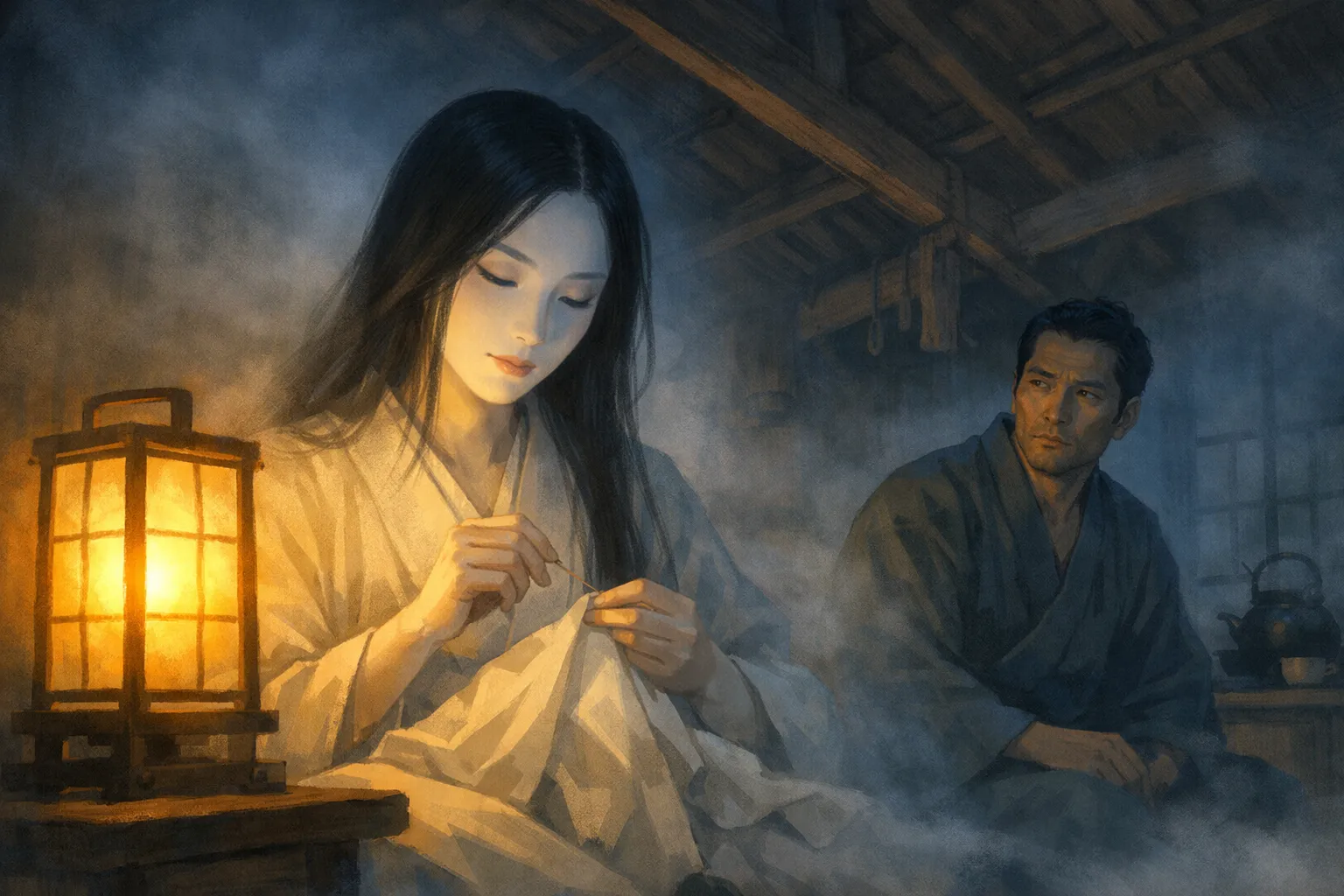
The frightening moment in Lafcadio Hearn’s “Yuki-Onna” does not arrive only during a blizzard. It returns years later inside a family home. A woman sews beside a paper lamp while her husband watches her face. Its beauty reminds him of something he once survived—and promised never to describe.
That contrast makes the Snow Woman more unsettling than a simple monster. The being who kills an old woodcutter also becomes a cherished daughter-in-law and the mother of ten children. Reading Hearn alongside Grace James’s later “The Cold Lady” reveals how small changes can shift the story from sudden supernatural terror toward the grief of a broken household.
A village legend, then a literary retelling
Hearn’s account appeared in Kwaidan in 1904. In his prefatory explanation of the story’s origin, he says a farmer from Chōfu, in Nishitama district of Musashi province, told it to him as a legend of the farmer’s native village. Hearn adds that he did not know whether it had previously been written in Japanese. That is a statement about his knowledge, not proof that no earlier Snow Woman narratives existed.
This distinction matters. We are reading a particular English-language literary telling attributed to a local Japanese informant, not a definitive scripture explaining every appearance of Yuki-Onna. The narrative itself supplies no shrine foundation, priestly genealogy, or formal teaching about the Snow Woman’s place among the kami.
Grace James subsequently retold the plot as “The Cold Lady.” The Library of America’s account of the two versions places her story in Green Willow and Other Japanese Fairy Tales (1910) and explains that she reworked several tales from Hearn’s books for children. Her version should therefore not be treated as independent confirmation of a separate regional tradition.
The useful comparison is between two tellings of Japanese folklore: what each author preserves, what each changes, and how those choices shape our sympathy.
The storm gives death a human face
In Hearn’s “Yuki-Onna”, Mosaku and his eighteen-year-old apprentice, Minokichi, are woodcutters returning home. A snowstorm strands them at a river after the ferryman has left. They shelter in his tiny hut, which has neither a brazier nor a place to make a fire. Their straw raincoats offer inadequate protection.
These practical details establish danger before the supernatural visitor appears. The men are not trespassing in a forbidden sanctuary or deliberately challenging a spirit. They are working people caught by weather.
Minokichi wakes to find the door open and a woman dressed in white bending over Mosaku. Her breath resembles luminous smoke. When she turns toward the younger man, he cannot cry out. Beauty and helplessness occupy the same instant: her face attracts him, but her eyes terrify him.
She spares him because of his youth and appearance, then imposes a condition. If he tells anyone what he has seen—even his mother—she will kill him. By morning Mosaku is dead, and Minokichi survives only after a prolonged illness. Read as an image of winter danger, the woman makes cold personal: it approaches, selects, touches, and sometimes passes someone by. That is an interpretation of Hearn’s scene, not an explanation he provides as doctrine.
The stranger becomes the center of the household
The next winter, Minokichi encounters a young traveler named O-Yuki. She says her parents have died and she hopes to find service in Yedo. He invites her home, where his mother welcomes her. Marriage follows, and the apparently vulnerable stranger becomes indispensable to the family, according to Hearn’s account of their domestic life.
Crucially, Hearn does not describe those years as an obvious nightmare concealed beneath a marriage. Minokichi’s mother praises O-Yuki, including in her final words. The couple have ten children. The villagers notice that O-Yuki remains exceptionally youthful, but the household prospers emotionally rather than collapsing under her presence.
The text gives readers a clue without making it conclusive. Hearn’s note explains that Yuki means snow and is also an ordinary personal name. Her name therefore carries a double possibility: it belongs both to the woman the family knows and to the force Minokichi fears.
This is a darker counterpoint to the protective relationships explored in our article on nature spirits in Japan’s farming traditions. Here, the central question is not how people secure prosperity from a supernatural presence, but whether family intimacy can survive without knowing that presence fully.
Grace James makes winter enter through summer
James preserves the broad sequence: two men, a fatal encounter, a promise of silence, a mysterious bride, children, and recognition. But her “The Cold Lady” removes the woodcutters’ names and occupation. They become an old traveler and a young traveler whose original purpose has been forgotten. The opening consequently feels less like a located village memory and more like a fairy tale deliberately freed from particulars.
Her most vivid alteration comes when the young man meets O’Yuki. Hearn places the meeting in winter; James chooses leafy summer. The girl faints from the heat, and he carries her home. As he holds her, he feels a slight chill but explains it away as evening coolness.
The change gives her strangeness a physical expression before anyone identifies it. Summer ought to separate this encounter from the blizzard, yet the cold travels with her. The man’s kindness also becomes more active: he rescues the woman who earlier spared him.
James gives the couple seven children rather than ten and explicitly describes their mother’s love and labor. O’Yuki works in the house and fields, while sunlight fails to darken her pale skin. These are details of this adaptation, not additional facts to combine indiscriminately with Hearn’s version. Together, they make her both a hardworking mother and someone who remains visibly outside ordinary bodily change.
A broken promise, but not the promised death
Both tellings bring recognition through lamplight and sewing. Seeing his wife’s face, the husband recalls the woman from the storm. O-Yuki invites him to explain, and he does. He does not set out to expose or defeat her. Conversation within the marriage breaks a prohibition established before the marriage began.
In Hearn’s abrupt ending, O-Yuki rises and reveals herself with terrifying force. She says she would kill Minokichi but for their sleeping children. She orders him to care for them and threatens punishment if they have cause to complain. Then her voice becomes windlike, and she dissolves into white mist that escapes through the smoke-hole.
James slows the departure. In her final household scene, O’Yuki folds her sewing and visits the children. One murmurs about the cold; she pulls his quilt over his shoulder. The youngest reaches toward her. Only afterward does she return to her husband and leave.
That adjustment changes the emotional emphasis without removing the danger. Hearn ends with a threat still hanging over the father. James allows us to watch maternal care continue during the separation itself. Her Cold Lady does not merely announce that the children matter; she tends them.
Neither version explains why she originally chose to become a wife, and neither needs a tidy answer. The children provide the decisive exception to the threatened killing, but they cannot preserve the marriage. The Snow Woman’s tenderness does not erase her lethal power. It makes her departure harder to read as either a monster’s defeat or a family’s deliverance.
Sources and further reading
- Lafcadio Hearn, Kwaidan: the author’s prefatory note, “Yuki-Onna,” and its explanatory notes.
- Grace James, Japanese Fairy Tales: chapter XIX, “The Cold Lady,” in the accessible Gutenberg edition.
- Library of America, “Lafcadio Hearn, ‘Yuki-Onna’”: publication context and the relationship between Hearn’s tale and James’s adaptation.


