
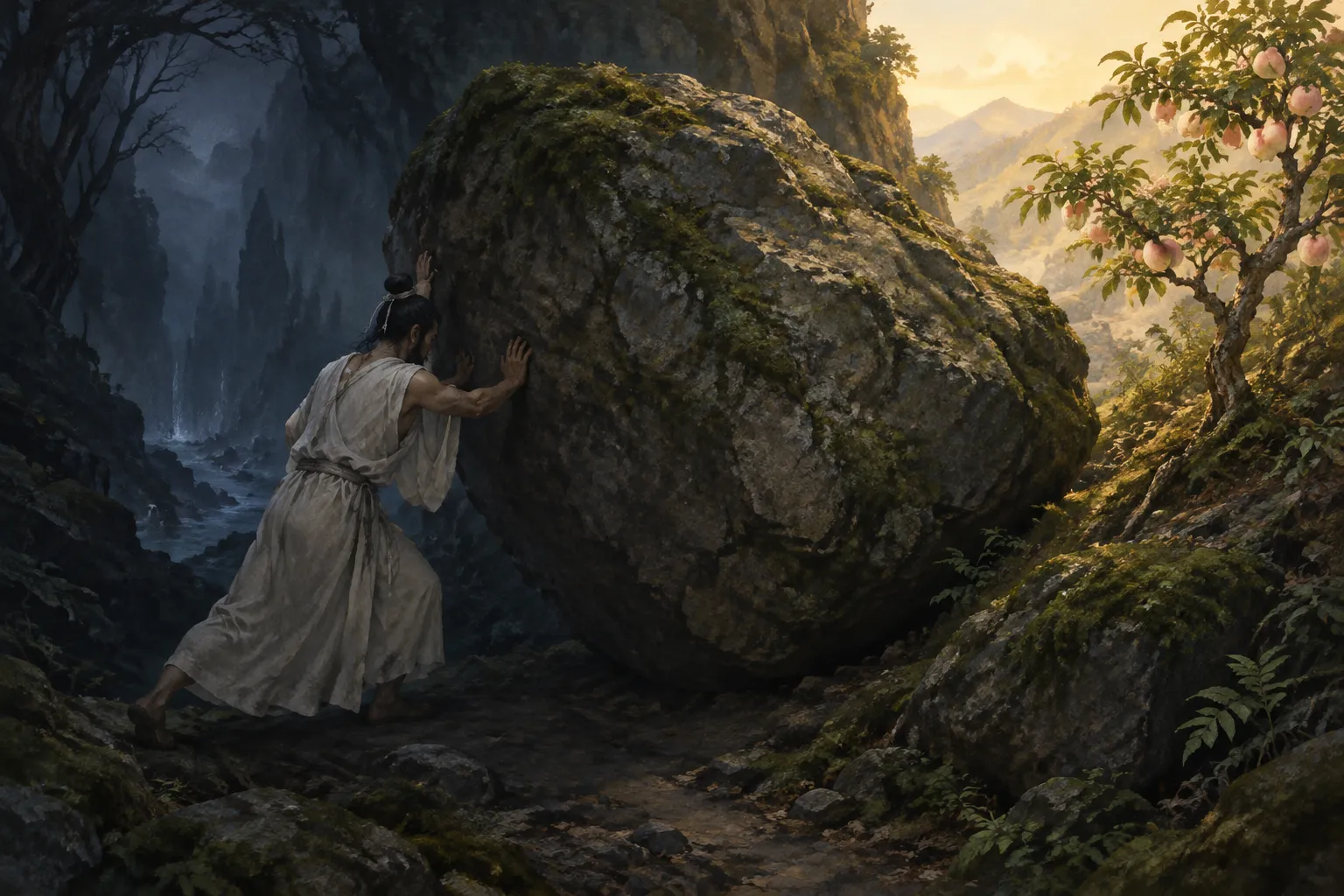
Izanagi reaches the passage out of the land of the dead, but escape does not mean reunion. His wife, Izanami, is coming after him. He blocks the way with an enormous boulder, leaving the two deities on opposite sides. In the Kojiki narrative retold by Nippon.com, the journey that began with an appeal to return together ends with a barrier neither spouse crosses.
Why does the story need that stone? Read closely, the episode is more than a frightening chase. It changes the question from whether one husband can recover his wife to how the living can continue in a world where death cannot simply be undone. The boulder is the turning point: rescue gives way to separation, and separation becomes a condition of ordinary life.
A rescue undone by looking
This article follows the Kojiki-centered account presented by Nippon.com, rather than combining every Japanese underworld tradition into one story. Izanagi follows Izanami to Yomi and asks her to return because their work of making the lands remains unfinished. She has already eaten the food of that realm, but agrees to consult its deities. While she does so, he must not look at her. These details belong to this particular narrative of the attempted return.
His waiting becomes unbearable. Using a tooth from his comb as a light, he looks and discovers her decomposing body, accompanied by thunder deities. He flees; she responds to the shame of being seen by sending pursuers after him. Nippon.com’s retelling preserves both his terror and her anger.
As a reading of the scene, the broken prohibition matters because the spouses no longer experience the encounter in the same way. He sees something from which he must escape. She experiences an exposure she expressly forbade. Calling her simply an evil monster would erase that difference. Calling him merely a devoted rescuer would overlook the act that turns negotiation into pursuit.
The story also leaves a painful question unanswered: what might have happened had he waited? It offers no completed consultation and no successful route back for Izanami. We should resist supplying a happy outcome that the narrative itself never grants.
Three peaches do what the sword cannot
Shimane Prefecture’s regional retelling of the escape describes a succession of defenses. Izanagi’s discarded hair band produces grapes; his comb produces bamboo shoots. The pursuing hags pause to eat. When thunder gods and an underworld army follow, however, swinging his sword behind him does not stop them. At Yomotsu Hirasaka, he takes three peaches from a tree and throws them, driving the pursuers back.
The distinction between these defenses is worth noticing. The grapes and shoots interrupt appetite: they buy time. The peaches reverse the direction of the chase. The sword, despite being the most obvious weapon, is not the decisive object. On a literary reading, the sequence asks us to watch what objects accomplish rather than rank them by their apparent strength.
It would nevertheless be a mistake to treat the peaches as a complete victory over death. They solve an immediate problem for the fugitive, not the problem with which his journey began. He has escaped the pursuing forces, but he has not restored his wife to life.
This is why the next action is so consequential. The story does not end with a triumphant warrior returning home. It pauses at a passage between worlds, where the remaining danger is also the person he originally came to recover.
The boulder changes the terms of the story
In Shimane’s account of the final separation, Izanami herself approaches, and Izanagi closes the entrance with a great boulder. Across it, she threatens to kill a thousand inhabitants of his world each day; he answers that he will create fifteen hundred people daily. The couple never meet again.
Those numbers should be read as the narrative’s explanation of the relationship between death and continuing birth, not as demographic measurements. Their force lies in the unequal balance: death takes people, but new life exceeds its losses. This interpretation follows the shape of their exchange rather than requiring us to imagine an ancient population count.
The stone also changes the kind of action possible. During the pursuit, movement is everything. Izanagi runs, casts objects behind him, and tries to keep distance between himself and his pursuers. Once the passage is blocked, movement gives way to speech. The spouses can address each other, but they cannot resume the shared journey he requested.
One useful way to understand the boulder, then, is as a limit rather than a weapon. It does not kill Izanami or erase Yomi. It keeps the realms apart. The narrative’s resolution is not that death disappears, but that the living world continues without reopening the road on the husband’s original terms.
Why escape still requires purification
The return has another stage. Kokugakuin University’s edition and commentary on the opening purification passage presents Izanagi declaring that he must cleanse himself after visiting the polluted realm. He removes and casts aside his belongings, and deities arise from them. The passage counts twelve deities born from the removal of things he had worn.
The university’s commentary distinguishes washing away pollution through misogi from harae, associated with expiation through offerings or compensation, while noting that the vocabulary can overlap. It also discusses disagreements over how the combined wording should be read. This is a useful warning against turning a complex textual episode into a single, timeless formula for every Shinto purification practice.
For this story, the important distinction is between getting out and becoming ready to continue. The boulder closes the route behind Izanagi; purification addresses what he carries away from the encounter. That is a literary interpretation of the sequence, not a claim that the text diagnoses a modern psychological condition.
Nor should pollution automatically be translated as moral wickedness. The commentary connects the episode with contact with death and the removal of its defilement. Read in that context, cleansing need not mean that visiting a deceased loved one was itself an evil intention.
A boundary remembered in Shimane
Yomotsu Hirasaka also has a local landscape. Shimane Prefecture identifies the traditional location in the Iya area of Matsue, near Iya Shrine, and describes large boulders associated with the blocked entrance. These are local identifications attached to the narrative, not archaeological proof that a deity physically sealed an underworld passage.
Keeping that distinction does not make the place unimportant. It lets us appreciate two different things without confusing them: a narrated boundary between life and death, and a landscape through which people remember that boundary. The story supplies a way of seeing the stones; the stones give the story a place at which to pause.
Readers interested in another Japanese narrative about an intimate relationship disrupted by supernatural identity can also explore our article on Yuki-Onna as wife and mother. That is a separate folklore subject, not another version of Izanami’s story.
At Yomotsu Hirasaka, the most unsettling object is ultimately not the sword or the fruit, but the stone that stays in place. It marks the failure of the desired reunion while making continued life possible. Izanagi returns, yet the ending refuses to pretend that returning means recovering everything he went to find.
Sources and further reading
- Nippon.com: Izanagi and Izanami: The Realm of the Dead — an accessible Kojiki-centered narrative.
- Shimane Prefecture: To the Underworld and Back — the escape, separation, and associated local landscape.
- Kokugakuin University: Misogi, part one — Japanese text, translation, and scholarly commentary on purification.


